Showing posts with label equilibrium. Show all posts

Why is there an equilibrium in the economy when AS=AD ?

Answer :

Because in such a situation, planned production in the economy is equal to planned purchases in the economy. The producers do not suffer:

(1) the burden of unwanted supplies or unsold stocks, or

(2) the loss of unfulfilled demand(due to lack of stocks)

When AS=AD, actual stocks with the producers = desired stocks with the producer.


State two approaches to the determination of equilibrium level of income in an economy ?

Answer :

Keyensian theory of income determination explains equilibrium level of income in terms of two approaches

1. Aggregate demand-aggregate supply approach

2. Saving- investment approach

In terms of Aggregate demand-aggregate supply approach, equilibrium level of income and output in the economy is the one where aggregate demand for goods and services is equal to the aggregate supply.

In terms of Saving- investment approach, equilibrium level of income is determined at that level of income where planned investment equals planned saving.

Also read:


Derivation of Investment Multiplier Formula

The multiplier formula can be derived by using the simple equilibrium condition for the two sector model i.e  
Y = C + I 
When there is an increase in investment by (∆I), it will lead to increase in income (∆Y) and this induces increase in consumption (∆C) i.e

∆Y = ∆C + ∆I 
Since, change in total consumption (∆C) equals change in income multiplied by MPC (marginal propensity to consume, “c”)

∆Y = c∆Y + ∆I

∆Y - c∆Y = ∆I
∆Y(1-c) = ∆I
∆Y = ( 1 / 1-c)  ∆I 
∆Y/ ∆I = 1 / 1-c

Graphic Presentation of Multiplier

Investment multiplier can also be explained with the help of the a diagram, as shown below:
investment multiplier
1) Income is shown along the X axis and Aggregate demand on Y axis.

2) The initial equilibrium is at point A, When AD = C + I

Short run equilibrium of the firm perfect competition

The short-run equilibrium of the firm can be illustrated by combining the short-run cost curve with 
the demand curve (AR curve) faced by the firm.Since the firm is price- taker, it has to decide 
the amount of output it should produce at the given price so as to maximise its profits.
Thus, the firm is output adjuster under perfect competition.
In order to determine the profit maximising output, the firmhas to meet two conditions :
1) Short run marginal cost curve = Marginal revenue, and SMC curve cuts the MR curve from below.
Since in perfect competition MR = AR = price (p), it follows that SMC = P.
This is the profit maximisation rule.
2) Perfect competition firms may be earning super-normal profits, incurring losses or 
just earning normal profits.Whether a firm makes abnormal profits or normal profits or losses 
depends on its cost and revenue conditions.Three equilibrium conditions can be seen.
a) AR > SAC, it means the firm is earning abnormal or supernormal profits.

super normal profit

As shown by the graph above, as short run average cost is below the P = AR = MR 
line at equilibrium, the firm earns super – normal  or pure profits as shown by the shaded area.
As the firm is covering all its cost thereby earning abnormal profits.

b) AR < SAC (but > AVC), then the firm is incurring losses
If the AR (P) > AVC, then he is covering entire variable costs and part of fixed costs as well. 
Here, losses in production would be less than losses in case of shut down, and the firm will definitely produce.
As shown by the below graph:

short run curve

As explained above, SAC lies above the price ( P= AR= MR), the firm is incurring losses shown by the shaded area. Since price exceeds AVC, the firm continues to produce in the short run (since loss is of fixed factors only so continue production) 
c) AR = SAC, it means firm is making only normal profits.

normal profit

As shown by the graph above, SAC is tangent to P = AR = MR line, the firm covers 
only its SAC,which includes normal profits. The firm, therefore earns normal profits 
(no profit no loss situation)

Short run supply curve of the firm in perfect competition
In a state of perfect competition, price is given to a firm.
Implying that, AR is constant for different levels of firm’s output.
Constant AR implies that AR=MR, 
so that the equilibrium condition that MR=MC can also be stated as P=MC.
At a given Price (P) a firm strikes its equilibrium when P=MC and MC is rising. Supply curve of the 
firm shows that various quantities of a commodity a firm is willing to supply at different prices.
The quantity which a firm is willing to supply at a particular price is determined by the equality 
of SMC and MR (=AR=P). By finding out equilibrium output at different prices and by joining 
different equilibrium points we an derive the short-run supply curve of the firm as shown by the 
below graph:

short run supply curve

1) At Po price (Po = ARo = MRo), SMC curve cuts MRo from below at Eo, giving  Eo as 
the equilibrium point and OQo as the equilibrium quantity. 
At Po price, firm is able to cover only variable cost since P=AVC.
The firm will not operate below this point and stop production since P <  AVC (firm is unable to 
cover variable as well as fixed cost). 
Eo is known as shut-down point because the firm would not like to operate below this.
OQo is the minimum supply of the firm in the short run.
2) If the price rises to P1, equilibrium point shifts to E1, where SMC = MR, and AR = SAC, and the 
equilibrium quantity increases to Q1.
Point E1, where SMC curve cuts the minimum point of SAC, is known as ‘break-even point’ 
because the firm is able to cover all costs at OP1 price.
Firm is just covering all its cost i.e. AR = AC.
At P1 price the firm will supply OQ1 quantity.
3) At P2 and P3 prices, equilibrium is at E2 and E3 respectively, and the amount supplied is OQ2 and 
OQ3 respectively. While producing OQ2 and OQ3 quantities of output, the firm is earning super 
normal profits since AR > SAC.
4) By joining Eo, E1, E2 and E3, we get the firm’s short run supply curve.
The part of short run MC curve which lies above the minimum point of AVC curve is the 
supply curve of the firm in the short run.
Supply curve of the firm in the short run is always upward sloping. 

Producer Equilibrium

Producer’s Equilibrium refers to a situation of ‘profit maximization’.
A producer strikes his equilibrium at that level of output where profit is maximized.
Any other output will yield lower profit.
Profit is calculated as the difference between TR (Total revenue) and TC (Total cost)
Profit = TR – TC
Profit maximization rules are also the rules of equilibrium of a firm.
These rules of a firm are common to all the firms operating under different market structure.
There are two ways of explaining how a firm reaches its equilibrium level of maximizing profits:
1) Total revenue and Total cost approach
2) Marginal revenue and Marginal cost approach

Some special cases of equilibrium

We have already explained the effects of change in demand and supply on the equilibrium price and quantity when demand and supply curves are normal slope, i.e. negatively sloping demand curve and positively sloping supply curve.
Let us consider how increase and decrease in demand affect equilibrium price in two exceptional situations:
1) When supply of the commodity is perfectly elastic        
2) When supply of the commodity is perfectly inelastic

When supply of the commodity is perfectly elastic
When supply curve is perfectly elastic i.e. supply curve is parallel to X axis, increase or decrease in demand  for a commodity does not cause any change in its price, equilibrium quantity tends to change
This is shown in the graph below:
perfectly elastic
perfectly elastic
E is the initial point of equilibrium when perfectly elastic supply curve(SS) intersect demand curve (DD). OP is the equilibrium price and OQ is the equilibrium quantity.
Forward shift in demand curve from DD to D1D1 leaves price of the commodity unchanged at OP. Equilibrium quantity increases from OQ to OQ1.Equilibrium point shifts to E1.
Backward shift in demand curve from DD to D2D2 leaves price of the commodity unchanged at OP. Equilibrium quantity decreases from OQ to OQ2. Equilibrium point shifts to E2.

Effect of Simultaneous changes in Demand and Supply

We have already discussed the effects of changes either in demand alone or in supply alone on the equilibrium price and quantity. But in reality changes in demand and supply take place simultaneously.  When demand changes, supply will also change as a consequence of that.

We will discuss below two situations of simultaneous changes in demand and supply :

a) Simultaneous Increase in Demand and Supply :
Simultaneous increase in demand and supply must cause increase in equilibrium quantity of the commodity.
But would there be any changes in price or not depends on whether demand increases more than, equal to, or less than supply.
So there can be three situations in this respect. As shown by the graphs below.

Change in Demand Supply and Market Equilibrium

We have already discussed the price determination of a commodity whose demand and supply curves are given, but generally demand and supply keeps on changing, resulting in shift in demand (factors like income, tastes and preferences etc.) and supply( change in technologies, input prices etc.) curves.
Let us now see the effect of change in demand and supply, on the equilibrium price and quantity.

Change in demand and Market Equilibrium
Change in demand has two aspects:
1) Increase in demand- demand curve shift to the right
2) Decrease in demand- demand curve shift to the left

Increase in demand:
demand supply
demand supply
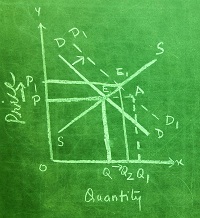
In the above diagram, DD and SS are the initial demand and supply curves. Equilibrium is struck at E, P and Q is the initial equilibrium price and quantity.

Determination of Market equilibrium Under Perfect Competition

Market equilibrium is a situation of the market in which demand for a commodity is exactly equal to its supply, corresponding to a particular price.
Thus, in a state of equilibrium, the market clears itself, as
Market demand = Market Supply

There is neither excess demand nor excess supply.
In this situation , the price that prevails in the market is called Equilibrium Price, Quantity supplied and demanded is called Equilibrium Quantity.

In a competitive market a single consumer or a single seller has no influence over the market price and so has no role to play in the determination of price.
Instead the price is determined in the competitive market through the interaction of market demand and supply.

How is the equilibrium price determined by the market forces of demand and supply?

Explanation through Table :
Price of X(apples) (Rs.)
Quantity Supplied
(kg/week)
Quantity demanded
(kg/week)
Market Position
5
4
3
2
1
50
40
30
20
10
10
20
30
40
50
Excess supply
Excess supply
Equilibrium
Excess demand
Excess demand

The above table shows as the price of commodity X falls, quantity demanded rises (law of demand)
and quantity supplied falls(law of supply).