Showing posts with label price determination. Show all posts

Time Element and Equilibrium Price

Equilibrium price is determined by the industry at that point where total demand is equal to total supply.
But, whether demand will have more effect or supply on the determination of the price, will depend on how much time will it take for the demand and supply to stabilize.
Importance of time element in the determination of price has been first examined by Dr. Marshall.
According to him, shorter the time period, greater will be the influence of demand in price determination and longer the period, greater will be the influence of supply on prices.

Marshall has divided the time elements into four periods:
1) Very short period or market period
2) Short period
3) Long period
4) Very long period

Very short period or market period
It is the time period during which supply of a commodity can be increased only up to the extent of its existing stock.
In case of perishable commodity which cannot be stored, supply becomes absolutely fixed or perfectly inelastic.

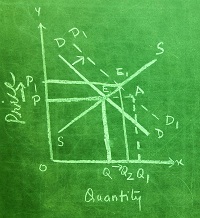
Effect of Simultaneous changes in Demand and Supply

We have already discussed the effects of changes either in demand alone or in supply alone on the equilibrium price and quantity. But in reality changes in demand and supply take place simultaneously.  When demand changes, supply will also change as a consequence of that.

We will discuss below two situations of simultaneous changes in demand and supply :

a) Simultaneous Increase in Demand and Supply :
Simultaneous increase in demand and supply must cause increase in equilibrium quantity of the commodity.
But would there be any changes in price or not depends on whether demand increases more than, equal to, or less than supply.
So there can be three situations in this respect. As shown by the graphs below.

Change in Demand Supply and Market Equilibrium

We have already discussed the price determination of a commodity whose demand and supply curves are given, but generally demand and supply keeps on changing, resulting in shift in demand (factors like income, tastes and preferences etc.) and supply( change in technologies, input prices etc.) curves.
Let us now see the effect of change in demand and supply, on the equilibrium price and quantity.

Change in demand and Market Equilibrium
Change in demand has two aspects:
1) Increase in demand- demand curve shift to the right
2) Decrease in demand- demand curve shift to the left

Increase in demand:
demand supply
demand supply
In the above diagram, DD and SS are the initial demand and supply curves. Equilibrium is struck at E, P and Q is the initial equilibrium price and quantity.

Determination of Market equilibrium Under Perfect Competition

Market equilibrium is a situation of the market in which demand for a commodity is exactly equal to its supply, corresponding to a particular price.
Thus, in a state of equilibrium, the market clears itself, as
Market demand = Market Supply

There is neither excess demand nor excess supply.
In this situation , the price that prevails in the market is called Equilibrium Price, Quantity supplied and demanded is called Equilibrium Quantity.

In a competitive market a single consumer or a single seller has no influence over the market price and so has no role to play in the determination of price.
Instead the price is determined in the competitive market through the interaction of market demand and supply.

How is the equilibrium price determined by the market forces of demand and supply?

Explanation through Table :
Price of X(apples) (Rs.)
Quantity Supplied
(kg/week)
Quantity demanded
(kg/week)
Market Position
5
4
3
2
1
50
40
30
20
10
10
20
30
40
50
Excess supply
Excess supply
Equilibrium
Excess demand
Excess demand

The above table shows as the price of commodity X falls, quantity demanded rises (law of demand)
and quantity supplied falls(law of supply).